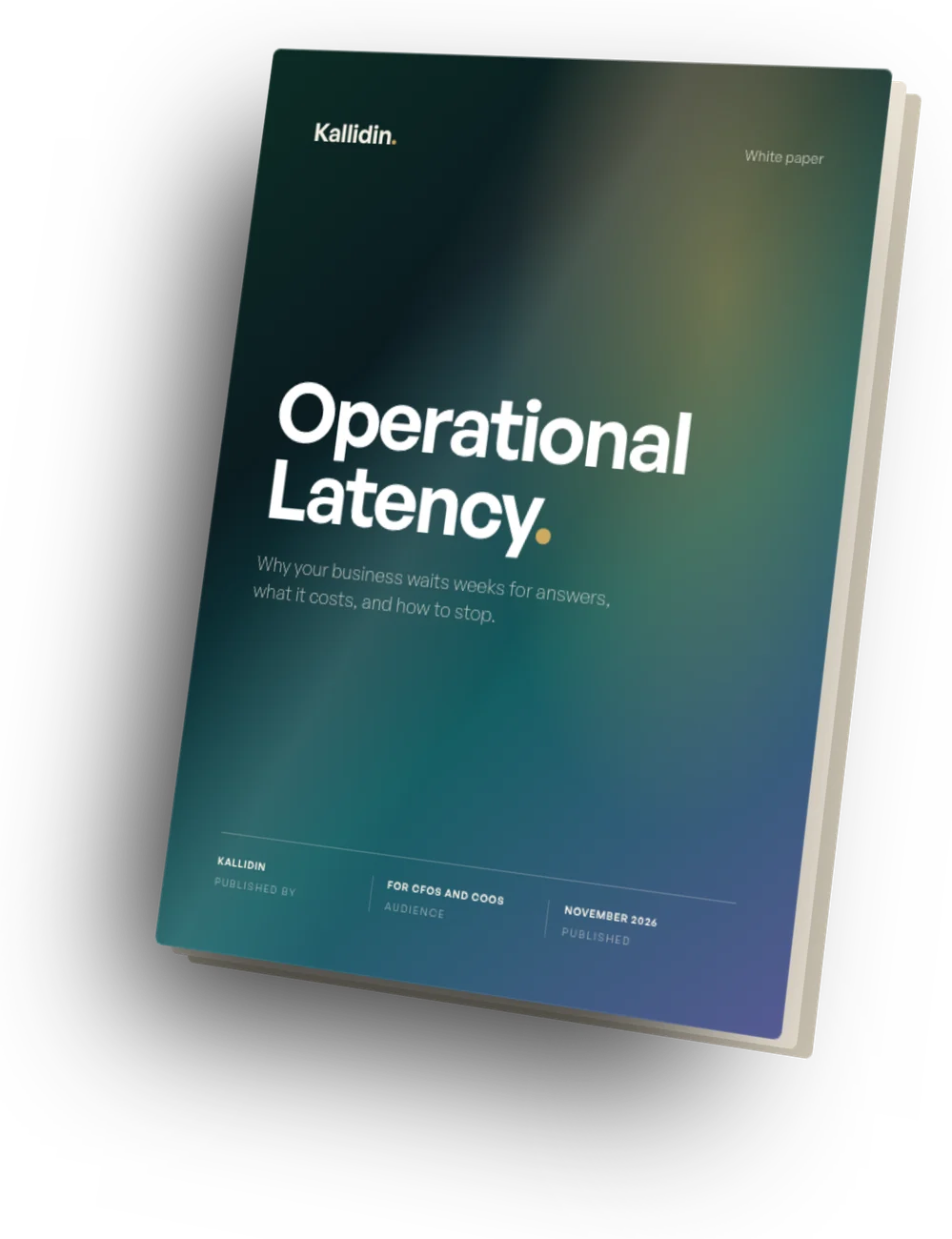
Operational
Latency.
Why your business waits weeks for answers, what it costs, and how to stop.
In brief.
Every business runs on questions, and almost none measures how long its answers take or what they cost. A board-grade answer takes around three weeks and costs around £16,400, fully loaded. Three forces cause the delay: a data team forced to choose what to drop every time a new question lands, a relay of hand-offs once the work starts, and definitions nobody has agreed. Hiring can’t close the gap. Changing how answers get made can.
Sources: Kallidin cost-per-answer model, 2026; EY, November 2025. Full method in the paper.
What’s inside.
Nine short sections, from the problem to what you can do about it on Monday.
- 01The answer arrives after the decision
- 02Three forces. One constraint.
- 03Analysis is the last function without a unit cost
- 04Put a number on it
- 05Speed is now the advantage
- 06The usual fixes only move the delay
- 07Add capacity, not another queue
- 08Measure it before you fix it
- 09Start on Monday
Get the paper.
Eleven pages for CFOs and COOs, with the numbers, the method and a plan you can start on Monday.
More white papers.
Get all four in one email → Who checks the agents?Why AI agents make mistakes, why checking them matters, and why people alone can’t check them at machine speed.Get the paper
 Say what you mean.Why AI needs a semantic layer, why the link between definitions and decisions has broken, and how to rebuild it.Get the paper
 Enough.Why the AI frontier should slow down, why the AI we already have is enough, and why mid-sized organisations should start now.Get the paper